 ultimate-guide
How to Handle Insurance Hail Claim Adjuster: 2026 Guide
Table of Contents
- What the Hail Claim Adjuster Actually Does
- Your Hail Damage Adjuster Inspection Checklist
- What to Say (and What Not to Say) During the Inspection
- ACV vs. RCV: Why the First Settlement Offer Is Rarely Final
- How to Dispute a Low Hail Insurance Estimate
- Benefits of Using a PDR Specialist for Insurance Claims
- Why Hail Inc. Is Built to Handle the Adjuster for You
- Frequently Asked Questions
Last Updated: September 10, 2026
What the Hail Claim Adjuster Actually Does
A hail claim adjuster is the insurance company's representative who inspects your vehicle after a storm, documents the damage, and determines what the insurer will pay. Understanding that role changes every conversation that follows.
Most vehicle owners treat the adjuster as an adversary. In practice, the adjuster works from a scope of work, a set of guidelines, and a timeline. At Hail Inc., we've sat through hundreds of these inspections across the Denver metro, and the drivers who get fair settlements are the ones who understand the process, not the ones who argue loudest.
The adjuster's job has three parts:
- Confirm the damage is consistent with a hail event
- Measure and document each affected panel
- Apply your policy's terms to produce a repair estimate
That third step is where most disputes begin.
Company Adjuster vs. Independent Adjuster
A company adjuster works directly for your insurer as an employee. An independent adjuster is a contractor the insurer hires during high-volume periods, often after a major storm, and may be less familiar with your policy.
Company adjusters usually have more authority to approve supplements on the spot; independent adjusters often have tighter limits and must route decisions back to the carrier. Knowing which one is standing in your driveway tells you how much flexibility you're likely to get.
Your Hail Damage Adjuster Inspection Checklist
Preparation is the biggest lever you control. A hail damage adjuster inspection checklist keeps you from missing evidence the adjuster never asks about and puts you in the same frame of reference the adjuster uses when scoring each panel.
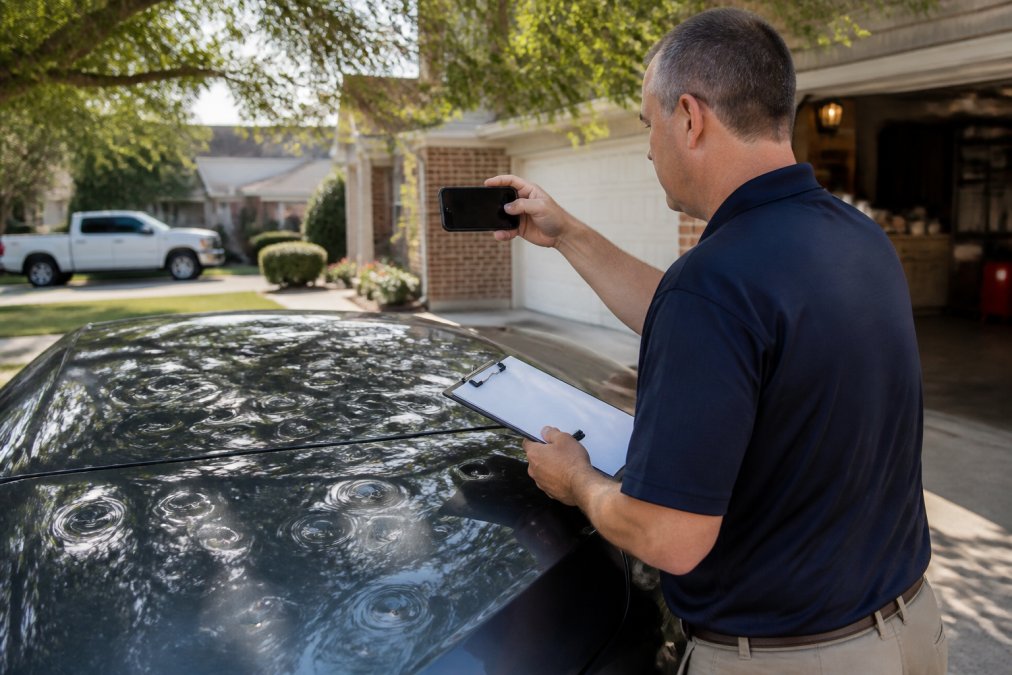
Before the appointment, gather:
- Photos of your vehicle from all four sides plus the roof, taken in daylight
- A short video walking around the vehicle while you narrate what you see
- Close-up shots of individual dents with a coin or ruler for scale
- Your policy declarations page and claim number
- Any prior repair receipts or a recent pre-storm photo of the vehicle
- A written storm log: date, time, approximate hail size, and duration
Photos, Video, and Notes to Gather First
Timing beats quality here. Hail damage gets harder to document once dust, rain, or a car wash obscures the surface, so shoot your evidence the same day you notice it.
Keep a written log too: the storm date, the date you filed, and the name of everyone you speak with. If a dispute arises later, that log becomes your timeline.
What Adjusters Actually Look For on Each Panel
This is the part most guides skip, and it decides your estimate. Adjusters are trained to distinguish hail impact from other surface conditions and score damage using a small set of criteria. Knowing the vocabulary lets you describe what you see in terms the adjuster already trusts.
- Dents with a defined crown. A true hail strike leaves a rounded impact with a raised edge where metal stretched. A shallow, irregular depression without a crown is usually not scored as hail.
- Granule loss on panel coatings. On vehicles, adjusters look for paint chipping or micro-cracking at the dent edge.
- Bruising. A bruise is a dent that has begun to stress the substrate beneath the surface. Bruising is the single most common reason a panel is approved for repair rather than denied as cosmetic.
- Pattern and density. Hail falls in a directional pattern. Isolated dents on one panel with none on adjacent panels are scrutinized; clusters consistent with the storm's path are accepted more readily.
- Soft metal vs. hard metal. Hoods, roofs, and trunk lids are typically softer and dent more easily. Quarter panels and pillars are reinforced and may show less visible damage for the same impact.
When you walk the vehicle with the adjuster, use these terms. "There's bruising along the crown of this dent" invites a measurement; "there's a dent here" invites a debate.
Pre-Inspection Walkthrough You Can Do Yourself
Before the adjuster arrives, do a slow pass with a bright LED flashlight held at a low angle to the panel. Mark each dent with removable painter's tape, count them by panel, and write the counts down. When the adjuster reads their scope aloud, you can compare counts in real time rather than discovering a gap weeks later. dealing with insurance adjusters.
Documents to Have Ready at the Appointment
Have these within arm's reach when the adjuster arrives:
- Declarations page showing coverage type and deductible
- Claim number and the assigned adjuster's name
- Your photo and video set, organized by panel
- Your written storm log and dent count by panel
- Prior repair documentation for the affected panels
If the adjuster asks for something you don't have, write it down and send it the same day. A complete file submitted promptly is harder to dispute than a partial one submitted late.
What to Say (and What Not to Say) During the Inspection
Keep answers factual and narrow. Describe what you observed and when, then let the adjuster do the measuring.
Say this:
- "The dents appeared after the storm on the 14th."
- "I have photos from the morning after."
- "I'd like a copy of the scope of work when it's ready."
Avoid this:
- Guessing at a dollar amount for the repair
- Speculating about damage you aren't sure exists
- Offering a recorded statement beyond basic claim facts
A recorded statement is a formal part of many claims and can be used later to challenge your position (naic.org). You are generally not required to give one on the spot; it's reasonable to say you'd like to review your documentation first and schedule it.
ACV vs. RCV: Why the First Settlement Offer Is Rarely Final
The gap between actual cash value and replacement cost value explains most lowball offers.
Actual cash value (ACV) is replacement cost minus depreciation (insurance.ca.gov). Replacement cost value (RCV) pays to restore the vehicle without deducting for age and wear (iii.org). Many policies pay ACV upfront and release recoverable depreciation once repairs are complete and documented.
That two-stage structure is why the first settlement offer is rarely the final number. It's often an ACV figure, not the full repair cost.
Your deductible applies either way and comes out of the settlement. Review your policy limits before you agree to anything, because the insurer will not pay beyond them regardless of the damage.
How to Dispute a Low Hail Insurance Estimate
You dispute a low estimate by documenting the gap between what the adjuster wrote and what the repair actually requires, then submitting that evidence in writing to a specific person with a specific ask.
The process looks like this:
- Request the full scope of work and the adjuster's photo set in writing
- Get an independent repair estimate from a qualified shop
- Compare line by line: panels, labor hours, materials, and any line items marked "not related"
- Submit a written rebuttal with photos and the second estimate attached
- Ask specifically for a supplement or a re-inspection, and name the deadline you need it by
Keep every communication in writing where possible. A dispute built on documented discrepancies is far stronger than one built on frustration.
How to Read the Scope of Work Line by Line
The scope of work is the adjuster's itemized repair plan, the document you are actually disputing. Read it like a checklist, not a summary.
- Panel count. Does the scope list every panel you documented? Missing panels are the most common gap.
- Repair vs. replace. Some line items say "repair" where the damage profile supports replacement. Ask what criteria drove that call.
- Labor hours. Compare the hours listed against the independent estimate. Large gaps usually mean the adjuster applied a different repair method.
- "Not related" or "pre-existing" notes. These are the adjuster's exclusions. Each one deserves a written response with your pre-storm photo or receipt attached.
- Betterment and depreciation lines. These reduce your payout. Confirm they match your policy's terms before accepting them.
Escalation Path When the Adjuster Won't Move
If the assigned adjuster won't revise the scope, use these escalation options in order.
- Ask for a re-inspection with a different adjuster. This is a routine request and is often granted.
- Request the adjuster's supervisor in writing. State the specific line items in dispute and the evidence supporting your position.
- File a complaint with your state's department of insurance. Every state has a consumer complaint process, and carriers are required to respond. This step is free and does not require an attorney.
- Invoke the appraisal clause if your policy includes one. Appraisal is a contractual dispute-resolution process where each side hires an independent appraiser, and the two appraisers select an umpire if they cannot agree. It is not a lawsuit, and it is frequently the fastest path to a binding number.
Supplementing a Claim After the Adjuster Leaves
A supplement is a request to add damage or cost the original estimate missed. It is routine, not adversarial, and it is the correct tool when hidden damage appears once panels come apart.
Supplements are the most underserved part of the hail claim process and where the largest recoveries usually happen. The original scope covers only what is visible on the surface; once a technician removes trim, headliner, or interior panels, additional damage frequently appears that the adjuster could not have seen.
How to file a supplement that gets approved:
- Document the hidden damage with photos before any repair work covers it up. Timestamped photos of the exposed area are the core of the supplement.
- Reference the original claim number and the specific line items you are adding. Do not file a new claim.
- Submit promptly. Most policies and state claim-handling rules expect additional damage to be reported within a reasonable window. Delays give the insurer grounds to question the connection to the original storm.
- Expect a second inspection. Many carriers send an adjuster back out to verify the supplement. Treat that visit the same way you treated the first one.
- Keep the supplement open until repairs are complete. Additional findings during the repair are common, and a closed supplement is harder to reopen than one that is still active.
What "Reasonable" Looks Like on Your Side
Insurers evaluate disputes partly on how reasonable the policyholder's conduct has been. Reasonable conduct means prompt reporting, documented evidence, written communication, and a willingness to allow re-inspection. The policyholder who stays organized and responsive is the one whose dispute gets resolved on the merits.
Benefits of Using a PDR Specialist for Insurance Claims
A paintless dent repair specialist documents damage differently than a general body shop, and that difference shows up in the estimate.
PDR technicians work the metal from behind the panel, preserving your factory finish and avoiding filler and repainting. For insurance purposes, that means:
- A more precise damage assessment, panel by panel
- Estimates that reflect actual repair time rather than replacement
- Preservation of original paint, which supports resale value
- A repair that often costs the insurer less, reducing friction on approval
This is the technical roof inspection criteria equivalent for auto claims: the person who understands how the panel actually behaves will document it more accurately than someone reading a damage chart.
Why Hail Inc. Is Built to Handle the Adjuster for You
Most vehicle owners face a hail claim adjuster once every few years. Hail Inc. handles them every week.
We work directly with insurance companies to manage your claim from first notice to final approval. Our certified technicians document damage to the standard adjusters expect, which means fewer disputes and faster approvals. We offer $0 out-of-pocket repairs, and we provide a complimentary rental vehicle even when your insurance doesn't cover one. Our valet pickup and drop-off service means you never have to rearrange your day around a shop visit, and every repair carries a lifetime warranty.
That's the practical answer to "why you": because the adjuster negotiation is the part most people get wrong, and it's the part we do for a living.
| Your Concern | What Hail Inc. Handles |
|---|---|
| Adjuster inspection | On-site documentation and coordination |
| Claim paperwork | Direct filing and follow-up with your insurer |
| Out-of-pocket cost | $0 out-of-pocket repairs |
| Transportation | Complimentary rental and valet service |
| Repair quality | Certified technicians, lifetime warranty |
Hail season in the Denver metro doesn't wait, and neither should your claim. The longer damage sits undocumented, the harder it becomes to prove. Hail Inc. takes the adjuster conversation off your plate entirely, from the first inspection through the final supplement, with $0 out-of-pocket repairs, a free rental car, valet pickup and drop-off, and a lifetime warranty on every repair. Schedule an online appointment with Hail Inc. and let our certified team handle the adjuster while you get back to your day.
Frequently Asked Questions
What should you not say to an insurance adjuster during a hail inspection?
Avoid guessing at dates, admitting the damage is old, or saying you are not sure it is worth claiming. Do not give a recorded statement before you have photos and a contractor estimate. Stick to facts you can verify: when the storm hit, what you observed, and where the damage is. If you are unsure about anything, say you will confirm and follow up rather than speculating on the spot.
Can insurance adjusters tell how old hail damage is?
Adjusters look for rust, dirt buildup in dents, paint cracking, and whether the damage matches the reported storm date. Fresh dents typically have clean metal and sharp edges. Older damage often shows oxidation or debris. This is why documenting the storm date with weather reports and photos before the adjuster arrives matters, especially on a hail damage adjuster inspection checklist.
What happens if the insurance adjuster misses hail damage on my vehicle?
You can request a re-inspection or file a supplemental claim. Take your own photos of every panel, compare them to the adjuster's scope of work, and submit the missed items in writing. A PDR specialist can provide a second estimate that itemizes dents the first inspection overlooked. Insurers are required to pay for covered damage, so a documented supplement is a normal part of the process.
Is it better to have a professional present when the insurance adjuster arrives?
Yes. A trained PDR technician or claim specialist can point out damage the adjuster may miss, speak the same technical language about panel access and repair methods, and document the inspection. Having a professional present also reduces the chance you say something that lowers your settlement. Many policyholders find the process faster and the offer fairer with representation on site.
How does Paintless Dent Repair affect the insurance claim process?
PDR preserves your factory paint and often costs less than conventional panel replacement, which can keep a claim from pushing toward a total loss. Insurers increasingly recognize PDR as a preferred repair method for hail damage. A PDR specialist can also justify repair over replacement in the estimate, protecting your vehicle's resale value and reducing downtime.