 ultimate-guide
What a Lifetime Paintless Dent Warranty Covers in 2026
Table of Contents
- What Is a Lifetime Paintless Dent Warranty?
- What the Lifetime Warranty Covers
- PDR Warranty Limitations and Exclusions
- How to Choose a Reputable PDR Technician
- PDR Repair Documentation Requirements
- Lifetime vs. Term-Limited Warranties
- Frequently Asked Questions
Last Updated: September 12, 2026
What Is a Lifetime Paintless Dent Warranty?
A lifetime paintless dent warranty is a written guarantee from a repair provider that covers the workmanship of a paintless dent repair (PDR) for as long as you own the vehicle. It typically promises that if a repaired area fails, the shop will fix it again at no charge. This guide from Hail Inc. explains what these warranties actually cover, where the fine print limits them, and how to tell a strong guarantee from a marketing line.
PDR itself is a non-invasive process. Technicians massage metal panels back to shape from behind the panel using specialized rods and picks, preserving your vehicle's factory finish. Because the original paint is never sanded or repainted, the repair can help preserve your vehicle's value. That is also why a workmanship guarantee matters: the entire result depends on the technician's skill, not on filler or fresh paint hiding imperfections.
Here's the tension most buyers miss. A "lifetime" warranty sounds absolute, but it usually covers only the quality of the repair, not new damage. Understanding that distinction before you sign is the difference between real protection and a piece of paper.
What the Lifetime Warranty Covers
A lifetime warranty generally covers two things: the workmanship of the repair and the integrity of the factory finish in the repaired area. If a dent the shop fixed re-appears on its own, or if the repair fails because of how it was performed, the provider repairs it again at no cost.
Workmanship Guarantee and Factory Finish
The workmanship guarantee is the core promise. It means the technician stands behind the method used to reshape the metal panel. A common approach is to cover:
- Re-appearance of a repaired dent caused by the original repair
- Failure of the metal to hold its reshaped form
- Issues tied to how the panel was accessed or worked
Factory finish coverage is narrower and more technical. It protects the original paint in the repaired zone. When PDR is done correctly, the factory paint stays intact, so there is no primer adhesion problem, no gloss deterioration, no blistering, peeling, or wrinkling that comes from repainting. A strong warranty states that the repair will not compromise that surface finish.
PDR Warranty Limitations and Exclusions
PDR warranty limitations are the conditions that void or narrow coverage, and they matter more than the headline promise. Most exclusions fall into predictable categories, so you can screen a provider quickly by asking about them directly. The goal here is not to memorize a list, it is to recognize the contract language that turns a "lifetime" promise into a narrow one. Scrutinizing these fine-print traps ensures you avoid similar pitfalls when evaluating the scope of auto glass warranty coverage.
The Exclusions You Will See Most Often
- New damage to the same panel from a separate event
- Dents on vertical panels, body lines, or panel edges where PDR is riskier
- Pre-existing damage the shop did not repair
- Repairs altered or reworked by another provider afterward
- Damage from rust, prior body work, or structural compromise
- Dents that require paint work, filler, or panel replacement to correct
Why Those Limits Exist (The Mechanism)
PDR works by slowly releasing stress in the metal from behind the panel. That works best on shallow, gradual dents with intact paint. Three physical limits drive most exclusions:
- Paint elasticity. Factory paint can stretch only so far (peer-reviewed research). A sharp crease or a dent with a hard crown has already stretched the paint near its limit, so pushing the metal back can crack or lift the clear coat. No honest warranty can promise a flawless finish there.
- Metal memory. Steel and aluminum remember their original shape to a point. Heavily stretched metal, common on large, deep dents, may not return fully, leaving a slight wave that is visible under certain light.
- Access. Vertical panels, reinforced edges, and areas behind structural braces limit where a technician can place a rod. Less access means more risk, which is why many warranties carve those areas out entirely.
A shop that explains these limits upfront is being straight with you. One that promises every dent will vanish is not.
The Fine-Print Checklist
Use this checklist to read the actual contract before you sign:
- Does the warranty cover workmanship only, or workmanship and factory finish?
- Are vertical panels covered, or excluded? (Many warranties cover horizontal panels only.)
- Is the warranty transferable to a new owner, and if so, how many times?
- Does coverage end if you sell the vehicle, or does it follow the vehicle?
- What voids coverage, another shop touching the panel, a DIY attempt, an insurance claim on the same panel?
- Is there a time limit to report a failed repair (for example, within 30 days of noticing it)?
- Does the warranty require routine inspections or proof of maintenance?
- Is the warranty backed by the shop or by a third-party administrator, and what happens if the shop closes?
That last question is the one almost nobody asks. A warranty is only as durable as the business standing behind it. If the provider is a single-location shop, ask how the warranty would be honored if the owner retires or the business changes hands.
How to Choose a Reputable PDR Technician
Choosing a reputable PDR technician comes down to three things: verifiable certification, a clear written warranty, and a process that documents the repair. Certifications signal that a technician has been trained and tested on the technique, not just self-taught.
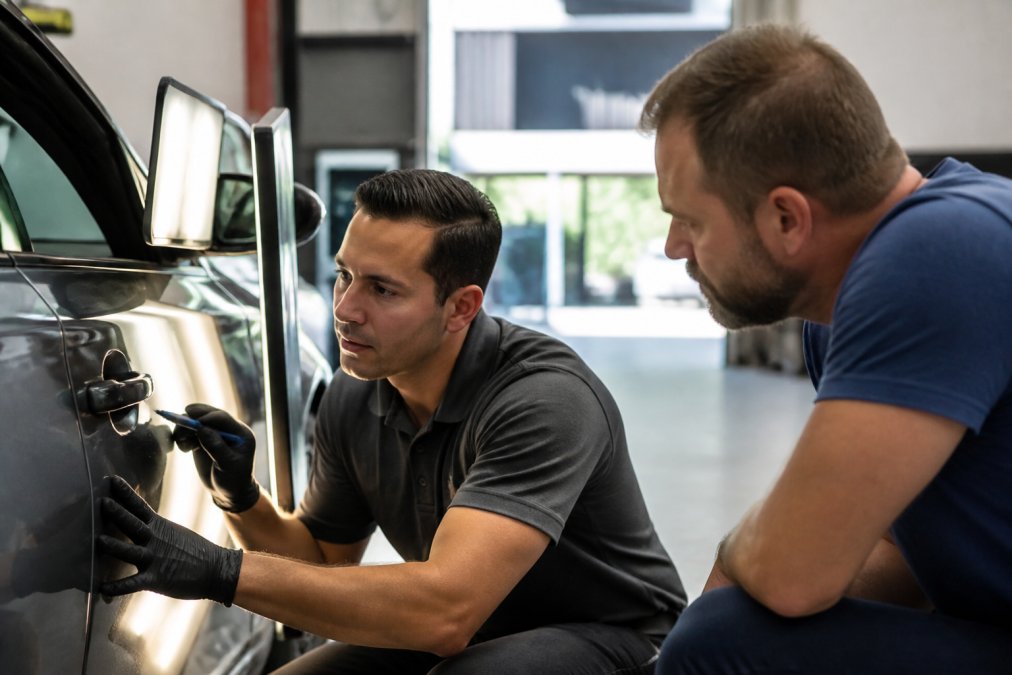
A common mistake is judging a shop by review count alone. Volume does not equal workmanship. What matters is whether the shop shows you its warranty terms before you commit, whether it photographs the damage, and whether it explains what PDR can and cannot achieve on your specific panels.
Use this checklist when vetting a provider:
- Asks to see the written warranty before you sign
- Confirms technician certification or training
- Photographs and documents the damage and the finished repair
- Explains exclusions in plain language, not just the promise
- Offers a transferable warranty if you plan to sell
- Provides a written estimate and timeline
The FTC guidance on warranties and guarantees is worth reading so you know your rights when a provider uses words like "lifetime" and "guaranteed."
PDR Repair Documentation Requirements
PDR repair documentation requirements protect both you and the shop. Without a record of the original damage and the completed work, a warranty claim becomes your word against the provider's. Good documentation starts before the repair and continues through pickup.
At minimum, your file should contain:
- Pre-repair photos of every dent, with a scale reference if possible
- A written description of the panels involved
- The signed warranty terms, including exclusions
- Post-repair photos of the same angles
- The date, technician name, and any certification details
Keep digital copies. If you sell the vehicle, a documented repair with a transferable warranty supports your resale value, because the buyer can see the work was done properly and is backed in writing. This is one of the clearest differences between a professional PDR job and a quick cash fix.
Lifetime vs. Term-Limited Warranties
The difference between a lifetime and a term-limited warranty is duration, and it changes how much protection you actually get. But the more important distinction, the one most buyers miss, is between a lifetime repair guarantee and a lifetime policy term. They sound the same. They are not.
Two Different Things Called "Lifetime"
- A lifetime repair guarantee is a workmanship promise from a repair provider. It says: if our repair fails, we will fix it again for as long as you own the vehicle. It covers the quality of the work, not new damage.
- A lifetime policy term is a coverage period attached to a protection plan or service contract. It says: you are enrolled in this plan for the life of the vehicle (or your ownership of it), and the plan pays for certain repairs during that window.
A repair guarantee is narrow but durable. A policy term is broader but usually carries conditions, deductibles, claim limits, transfer fees, and maintenance requirements. When a provider advertises a "lifetime warranty," ask which of the two you are getting. The answer changes what you can actually claim.
Side-by-Side Comparison
| Warranty Type | Duration | Typical Coverage | Best For |
|---|---|---|---|
| Lifetime repair guarantee | As long as you own the vehicle | Workmanship and factory finish on the panels the shop repaired | Owners keeping a vehicle long-term |
| Term-limited guarantee | Fixed period, often 2-5 years | Workmanship only, sometimes prorated | Short-term owners or leased vehicles |
| Transferable lifetime guarantee | Transfers to the next owner, usually once | Same as lifetime, with conditions | Owners planning to sell |
| Lifetime policy term (service contract) | Life of the vehicle or your ownership | Defined repairs under plan terms, often with a deductible | Buyers who want broader coverage |
How Vehicle Age and Mileage Change the Picture
- Newer vehicles. A lifetime repair guarantee is straightforward. The panels are original, the paint is intact, and PDR results are predictable.
- Mid-life vehicles (roughly 5-10 years). Prior repairs, minor rust, and aging clear coat start to matter. A warranty may still apply, but the shop will inspect more carefully and may exclude panels with existing paint work.
- Older or high-mileage vehicles. Coverage is often still available, but the practical value drops. If the vehicle is worth less than the cost of a future repair, a lifetime guarantee has less real-world benefit. Some providers also cap coverage by mileage or exclude vehicles past a certain age, read the terms.
For used-car buyers, the key question is whether the warranty transfers and whether it survives a change of ownership. A transferable lifetime guarantee can add genuine value at resale, because the next buyer inherits documented, backed work. A non-transferable one ends the moment you sign the title over.
What to Ask Before You Compare
- Is this a repair guarantee or a policy term?
- Does it transfer, and how many times?
- Does it expire with mileage or vehicle age?
- What is the deductible, if any?
- Who administers it, the shop or a third party?
Lifetime coverage sounds better, and it usually is, but read the conditions. The label alone tells you nothing; the terms do.
Consumer advice on understanding auto repair warranties explains how to compare the fine print across providers.
Frequently Asked Questions
Does a lifetime paintless dent warranty cover future damage?
No. A lifetime paintless dent warranty covers the quality of the original repair, not new dents from future events. If a new dent appears, it is treated as a separate claim. The warranty ensures the repaired area holds up, but it does not provide ongoing dent protection. Review your warranty terms to confirm what is covered.
Are there limitations to a lifetime warranty on PDR?
Yes. Common PDR warranty limitations include pre-existing damage, rust or corrosion, improper prior repairs, and damage to areas with compromised paint or primer adhesion. Warranties also typically exclude damage from neglect or accidents. Always read the fine print and ask the shop to clarify what voids coverage before you sign.
What documentation do I need to keep for a lifetime PDR warranty?
Keep your original repair invoice, warranty certificate, before-and-after photos, and any inspection reports. PDR repair documentation requirements vary by shop, but these records prove the repair date and scope. If you sell the vehicle, transfer these documents to the new owner to maintain coverage.
Does a lifetime paintless dent warranty transfer if I sell my vehicle?
Transferability depends on the shop. Some lifetime warranties transfer to the next owner at no cost, while others require a transfer fee or are non-transferable. Ask the technician upfront whether the workmanship guarantee follows the vehicle or the original purchaser. A transferable warranty can be a selling point when you list your car.