 how-to
Can You Choose Your Own Repair Shop for Hail Damage?
Table of Contents
- Your Legal Right to Choose Your Own Repair Shop for Hail Damage
- Preferred Provider Networks vs. Independent Shops
- Understanding the Hail Damage Insurance Claim Process
- What to Look for in PDR Technician Qualifications
- Mobile Dent Repairs Near Me: Convenience Without Compromise
- How Insurance Estimates Work With Independent Shops
- What to Do if Your Insurance Company Pressures You
- Conclusion
- Frequently Asked Questions
Last Updated: September 23, 2026
Your Legal Right to Choose Your Own Repair Shop for Hail Damage
Yes, you have the legal right to choose repair shop hail damage services. This is a fundamental consumer protection that applies across the country. Your insurance policy cannot force you to use a specific repair facility, and no insurance company can legally pressure you into using their preferred provider network.
Insurance companies benefit when you use their preferred shops because those facilities accept lower reimbursement rates. Your right to choose remains protected by state insurance regulations and consumer protection laws.
You control where your vehicle gets repaired. The insurance company pays the claim. Those two things are separate.
At Hail Inc., we work with vehicle owners who want to take control of their repairs while navigating complex insurance claims. We handle the claim process directly with insurers, so you don't have to fight for coverage while also managing the repair timeline.
Preferred Provider Networks vs. Independent Shops
Insurance companies create preferred provider networks to simplify claims and reduce costs. When you use a shop in their network, the insurer handles payment directly with that facility. But speed for the insurance company doesn't always mean better service for you.
Independent shops offer distinct advantages:
- You choose based on reputation and expertise, not insurance convenience
- Local technicians often know regional damage patterns better
- No pressure to rush repairs to meet network quotas
- Direct communication without an insurance adjuster as a middleman
Preferred provider networks offer:
- Simplified claims processing
- Faster initial scheduling in some cases
Your insurance company's preferred network exists to benefit them, not you. Choose based on what serves your vehicle and your timeline.
Understanding the Hail Damage Insurance Claim Process
Understanding the hail damage claim process helps you identify where insurance pressure appears and where supplements become critical.
Step 1: Report the damage immediately. Contact your insurance company as soon as hail strikes. Document the damage with photos and video. Most insurers require notification within 30 days.
Step 2: Schedule an inspection. The insurance company sends an adjuster to assess damage and write an estimate. The adjuster's job is to determine what the insurer will pay, not what the repair actually costs. Adjusters typically spend 30-60 minutes on-site and cannot see damage hidden under trim and panels.
Step 3: Get your own estimate. Get an independent estimate from a certified technician outside your insurer's network. Compare it line-by-line against the adjuster's estimate. Labor rates, damage scope, and repair method often diverge significantly.
Step 4: Understand the supplement process. This is the mechanism most policyholders don't know about, and it's where your right to choose your shop becomes essential.
During repair, your chosen shop will discover damage the adjuster missed. This happens in nearly every significant hail claim because hidden dents only become visible once trim and panels are removed, and damage to structural components isn't apparent from exterior inspection.
When your shop finds this additional damage, they document it with photographs, measurements, and a detailed written description. They then submit a supplemental claim (also called a "supplement") to your insurance company. This is a formal request for additional payment beyond the original estimate.
Your insurance company must pay for documented damage, even if the adjuster missed it. However, insurers often resist supplements by requesting proof the damage is new, claiming it's cosmetic, delaying review, or offering partial payment.
Your shop's role in supplements is critical. A shop experienced with insurance claims will document damage with dated photos, provide written descriptions explaining why damage wasn't visible initially, and communicate directly with the adjuster.
If your insurance company denies a supplemental claim for damage your shop documented during repair, this is a violation of your policy contract. Document the denial in writing, request the insurer's written explanation, and file a complaint with your state's insurance commissioner if the company refuses to pay for visible, documented damage.
What to Look for in PDR Technician Qualifications
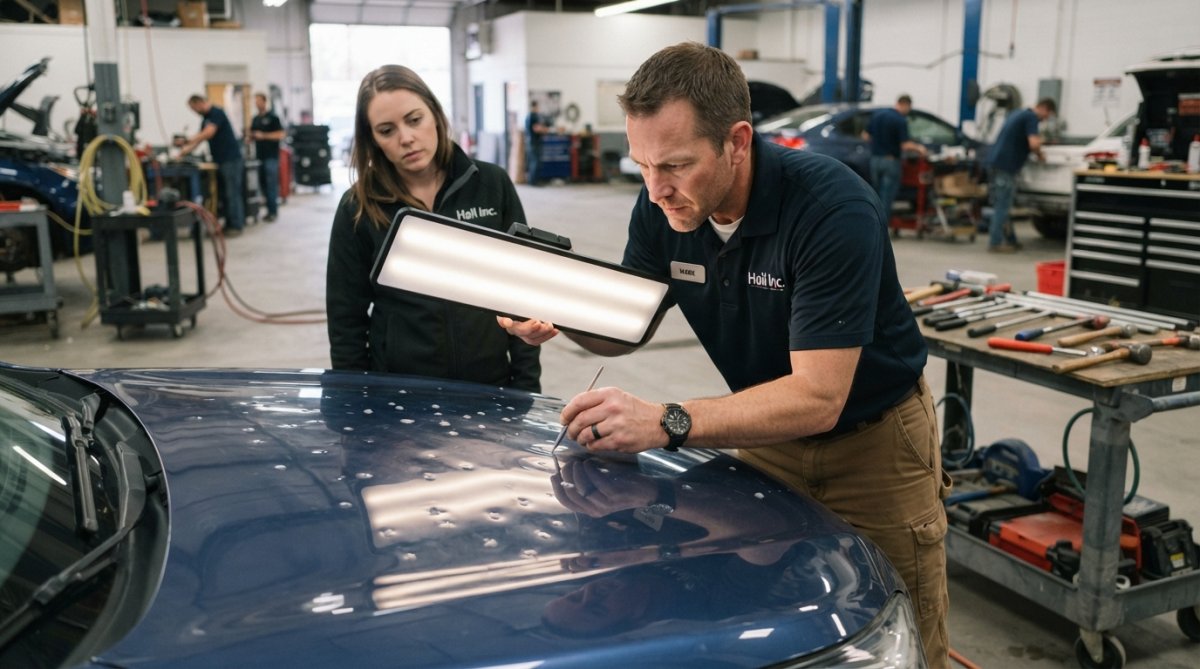
Paintless dent repair (PDR) requires specialized skills that differ from traditional body shop work. Certifications matter, but knowing how to verify them is equally important.
Certification standards that matter:
How to verify certifications:
Don't accept a shop's word that their technicians are certified. Ask for:
- The technician's name and certification number. A legitimate certified technician can provide this immediately.
- Permission to verify the certification directly. You can contact the certifying body to confirm the technician's current certification status. Most shops will not object to this verification, if they do, that's a red flag.
- A copy of the certification or a photo of the credential. Legitimate shops display certifications or provide copies without hesitation.
Experience level and damage scope:
Match the shop's experience to your claim severity:
- Minor hail damage: A certified technician with 2-3 years of PDR experience is sufficient.
- Moderate hail damage: Require 5 years of PDR experience and a track record of handling numerous hail claims.
- Severe hail damage: Require 7+ years of experience and a track record of managing complex supplements.
Insurance claim experience and supplement capability:
- "How many supplemental claims has your shop filed in the past year?"
- "What's your average supplement approval rate?"
- "Do you communicate directly with insurance adjusters?"
- "If the insurance company denies a supplement, what's your appeal process?"
Warranty and accountability:
Red flags when evaluating shops:
- Cannot provide technician names or certification numbers
- Technician has less than 3 years of PDR experience for your damage level
- No record of filing supplemental claims
- Pressures you to accept the adjuster's estimate without independent assessment
- Cannot explain the difference between PDR and traditional repair methods
- Quotes significantly lower than competitors
Mobile Dent Repairs Near Me: Convenience Without Compromise
Mobile PDR services bring repairs to your location, appealing to busy professionals. However, quality varies dramatically.
Advantages:
- Repairs at your location
- No vehicle drop-off needed
- Faster turnaround for minor to moderate damage
Limitations:
- Weather-dependent
- Limited to paintless dent repair
- Technician skill varies widely
How Insurance Estimates Work With Independent Shops
Your insurance company's estimate and your chosen shop's estimate often differ. Insurance adjusters write estimates based on what they can see during a 30-60 minute inspection and have an incentive to minimize payout. Your independent shop's estimate reflects detailed inspection and actual labor costs. These estimates diverge because hidden damage becomes visible once work starts.
What to Do if Your Insurance Company Pressures You
Insurance companies sometimes pressure policyholders to use preferred provider networks with statements like "We can only cover repairs at our preferred shops" or "Using an independent shop will void your coverage." None of these statements are legally accurate. Your right to choose your repair shop is protected by state insurance law.
How to respond:
- State your choice clearly: "I'm choosing [Shop Name] for my repairs."
- Get pressure in writing to create a record.
- Reference your policy language about your right to choose repairs.
- Escalate to the claims manager if needed.
- Contact your state insurance commissioner if the company refuses to honor your choice.
Conclusion
Choosing your own repair shop for hail damage is your legal right, and it's a right worth exercising. Insurance companies benefit when you use their preferred networks, but that benefit flows to them, not to you. Your vehicle deserves repair from a certified technician using methods that restore it properly, not methods that minimize the insurer's payout.
Frequently Asked Questions
Am I legally required to use an insurance company's preferred repair shop for hail damage?
No. You have the legal right to choose your own repair shop for hail damage, even if your insurance company has a preferred provider network. Your policyholder rights protect this choice. Insurance companies cannot force you to use their preferred shops, though they may encourage it. Always review your insurance policy language to understand your specific coverage and any incentives for using network providers.
What should I look for when selecting a reputable PDR technician for hail damage?
Look for certified technicians with credentials in paintless dent repair. Verify their experience with hail damage claims and whether they work directly with insurance companies. Check that they offer warranty coverage on repairs and can provide references. Ask about their process for vehicle inspection and whether they handle the supplemental claim process if initial estimates are too low.
Can I use a mobile dent repair service for hail damage covered by insurance?
Yes, many insurance policies cover mobile dent repair services for hail damage. Mobile PDR technicians can inspect your vehicle at home or work and often handle the insurance claim process directly. Confirm with your insurer that the mobile service is authorized and that the technician is properly licensed. Mobile services offer convenience without compromising repair quality when performed by qualified technicians.
What happens if my insurance company's estimate is lower than my chosen shop's estimate?
You can request a supplemental claim process. If your independent shop's estimate is higher, document the difference and submit it to your insurance adjuster. Your chosen repair facility can work with the adjuster to justify additional costs for OEM parts, labor, or hidden damage discovered during repair. Keep detailed documentation of all estimates and communications throughout the claims process.