 how-to
How Paintless Dent Repair Preserves Resale Value
Table of Contents
- What Is Paintless Dent Repair and How Does It Work?
- Why Factory Paint Finish Importance Cannot Be Overstated for Resale
- PDR vs Traditional Repair Resale Value: What the Data Shows
- Is Paintless Dent Repair Permanent? What You Need to Know
- Vehicle History Reports and PDR: What Carfax and AutoCheck Show
- Lease Returns, Trade-Ins, and Insurance: How PDR Protects You
- Conclusion: Protecting Your Investment with Paintless Dent Repair
- Frequently Asked Questions
Last Updated: September 17, 2026
What Is Paintless Dent Repair and How Does It Work?
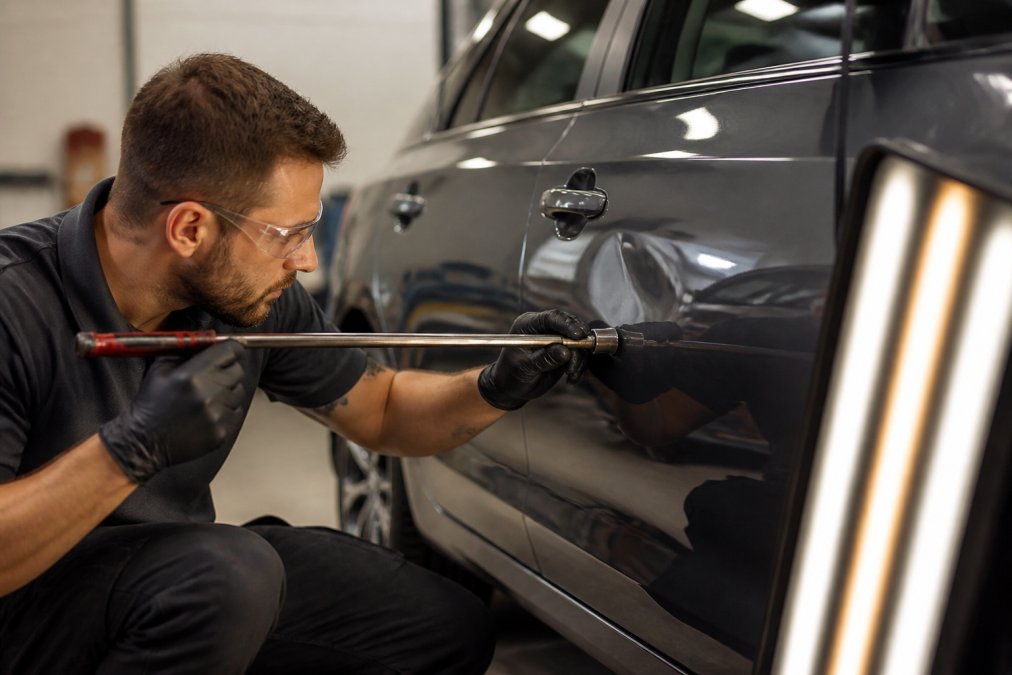
Paintless dent repair removes dents from a vehicle's body panels by reshaping the metal from behind, without sanding, filling, or repainting. Technicians use specialized rods to push the metal back to its original shape, preserving the factory finish.
The process works because steel has a property technicians call metal memory. When a panel is dented, the metal stretches and bends but still "remembers" its original shape, and a skilled technician applies pressure in precise increments to work it back toward that form.
A common mistake is assuming any dent means a body shop visit. Most shallow-to-moderate dents with intact paint can be repaired this way; the determining factors are paint condition, dent location, and how much the metal has stretched.
The Role of Metal Memory in PDR
Metal memory is the tendency of a deformed steel or aluminum panel to return to its original contours when pressure is applied correctly. Technicians rely on it to work dents out gradually rather than forcing the metal into a new shape. Panels stretched beyond their elastic limits may not respond fully, which is why dent severity matters during assessment.
Why Factory Paint Finish Importance Cannot Be Overstated for Resale
Factory paint finish importance comes down to one thing: buyers and appraisers treat original paint as proof the vehicle hasn't been structurally compromised. Original finish signals careful ownership; repainted panels raise questions that lower offers.
Automotive appraisers routinely measure paint thickness with a gauge to detect bodywork.
PDR vs Traditional Repair Resale Value: What the Data Shows
The PDR vs traditional repair resale value comparison favors paintless methods for one structural reason: traditional repair requires destroying the factory finish to fix the metal underneath. Once a panel is sanded, filled, and repainted, it can never be returned to original status.
| Factor | Paintless Dent Repair | Traditional Body Shop Repair |
|---|---|---|
| Factory paint | Preserved | Removed and replaced |
| Body filler used | None | Common |
| Paint thickness readings | Factory spec | Detectable deviation |
| Typical resale impact | Minimal | Reduced market value |
| Repair time | Often same-day | Multiple days |
How Body Filler and Repainting Hurt Your Car's Market Value
Body filler, often called Bondo, is a paste applied to smooth out dents before painting. It's effective, but it's permanent evidence of repair: paint thickness gauges detect it instantly, and any inspection that reveals filler tells a buyer the vehicle had damage significant enough to require refinishing.
Is Paintless Dent Repair Permanent? What You Need to Know
Yes, paintless dent repair is permanent when performed correctly on a suitable dent. The reason is mechanical: the technician moves the metal itself back toward its original contour, so there is no filler to crack, shrink, or separate, and no repainted surface to fade at a different rate. A properly worked repair holds for the life of the panel.
- Paint integrity. If the paint over the dent is cracked, crazed, or visibly stretched, the finish has already failed and cannot be restored by pushing metal from behind. Those dents fall outside paintless repair.
- Metal stretch. Steel and aluminum deform elastically up to a point, then permanently. A dent that has pushed the metal past its elastic limit leaves excess material that has to go somewhere, and a technician may not be able to return the panel to a factory-flat reading.
- Location. Dents near panel edges, crease lines, or reinforced inner structures limit tool access and reduce how precisely the metal can be worked.
Why Permanence Matters More at Resale Than at Repair
A repair that holds is not the same as a repair that is invisible to a future buyer. Permanence protects you twice:
- Physically. No filler means nothing to shrink, crack, or telegraph through the finish months later, which is the failure mode that turns a cheap repair into an expensive one.
- Documentarily. A repair that leaves no filler and no repaint leaves nothing for a paint gauge to flag, so the panel still reads as factory-original at trade-in or private sale.
When a Repair Is Not Permanent
Permanence assumes the panel is not damaged again. A new impact in the same area can re-deform metal that was previously worked, and repeated repairs in one spot gradually reduce how much the panel can be moved back. That is one reason a documented, single, well-executed repair is worth more than a panel worked over several times.
Vehicle History Reports and PDR: What Carfax and AutoCheck Show
Paintless dent repair typically does not appear on a vehicle history report. Carfax and AutoCheck compile data from insurance claims, police reports, service records, and title events, so a PDR repair paid out of pocket generally leaves no reportable trace.
Lease Returns, Trade-Ins, and Insurance: How PDR Protects You
Lease returns, trade-in appraisals, and insurance claims each apply their own scrutiny, and each treats a paintless repair differently than a conventional one.
Lease Return Inspections: Where PDR Pays for Itself Fastest
Lease agreements almost always include a wear-and-tear standard, enforced at turn-in. An independent inspector walks the vehicle against a damage matrix that grades dents by size and by how many appear on a single panel. Dents below the threshold count as normal wear; dents above it are billed back as excess wear charges, assessed per panel, so several small dents can add up quickly.
Trade-In Appraisals: What the Appraiser Actually Checks
Dealers appraise trade-ins with two tools that matter here: a paint thickness gauge and a vehicle history report. The gauge detects filler and repaint; the report detects reported damage events. A paintless repair that leaves the factory finish intact and generates no reportable event passes both checks, which is why it holds value better.
Insurance Claims and PDR: How the Two Differ
A paintless repair handled as an insurance claim is still a claim. It is recorded by the insurer and, depending on the carrier and reporting practices, can surface on a vehicle history report as a damage or claim event even though no bodywork was performed.
That creates a genuine trade-off:
- Filing a claim may cover most or all of the repair cost, but it can attach a claim record to the vehicle that a future buyer or appraiser will see.
- Paying out of pocket keeps the repair off the reported history, which preserves the clean record, but you absorb the cost yourself.
The repair method you choose affects three things at once: the physical condition of the vehicle, its documented history, and its appraised value. Paintless repair protects the first, and how you handle the claim protects the second and third.
Conclusion: Protecting Your Investment with Paintless Dent Repair
Every dent is a decision point, and the method you choose determines whether your vehicle's value stays intact or takes a documented hit. At Hail Inc., we specialize in paintless dent repair for hail damage and everyday dents across the Denver metro area, with certified technicians, direct insurance claim handling, and $0 out-of-pocket repairs. We also provide complimentary rental vehicles and valet pickup and drop-off, so your schedule never has to bend around the repair.
Frequently Asked Questions
Does paintless dent repair show up on a vehicle history report?
No, paintless dent repair typically does not appear on vehicle history reports like Carfax or AutoCheck because it is a non-invasive process that does not involve structural repairs or insurance claims in most cases. Since PDR preserves the original factory paint and does not require panel replacement or body filler, there is no damage record reported to these services. This means your car's history stays clean, which helps maintain its resale value.
Is paintless dent repair considered a permanent solution?
Yes, when performed by a certified technician, paintless dent repair is a permanent solution. The process uses specialized tools to manipulate the metal back to its original shape without damaging the paint or clear coat. Once the dent is removed, it will not reappear unless the vehicle sustains new damage. Hail Inc. backs their PDR work with a lifetime warranty, giving you confidence that the repair will hold up over time.
What are the downsides of paintless dent repair?
PDR works best on shallow dents with intact paint and on panels that are accessible from behind. It may not be suitable for dents with cracked or chipped paint, sharp creases, or areas where the metal is stretched beyond repair. In those cases, traditional body work may be necessary. However, for most hail damage and minor dents, PDR is the preferred method because it preserves factory paint and resale value.
How does paintless dent repair differ from traditional body shop methods?
Traditional body shops often use body filler, sanding, and repainting to fix dents, which can diminish your car's value because it no longer has the original factory paint. Paintless dent repair, by contrast, uses specialized tools to massage the metal back into shape from behind the panel. This non-invasive approach keeps the factory finish intact, avoids paint matching issues, and typically costs less while preserving your vehicle's resale value.