 how-to
How to Identify Quality PDR Work: A Step-by-Step Guide
Table of Contents
- What Makes Quality PDR Work Stand Out
- Signs of Bad Paintless Dent Repair to Avoid
- Using Lighting Techniques to Inspect PDR Quality
- Questions to Ask a PDR Technician Before Repair
- PDR Technician Certification Requirements and Standards
- Post-Repair Inspection Checklist
- Understanding Warranties and Quality Guarantees
- Frequently Asked Questions
Last Updated: September 19, 2026
What Makes Quality PDR Work Stand Out
To identify quality PDR work, understand that quality paintless dent repair restores your vehicle's body panels to their original condition without repainting. The hallmark of excellent PDR is a seamless finish that blends perfectly with the surrounding paint, leaving no trace that damage ever occurred.
A properly executed repair maintains the vehicle's factory paint, preserves resale value, and requires no body filler. The technician uses specialized tools to access dents from behind the panel, carefully manipulating the metal back to its original shape.
The best PDR work is nearly invisible, no ridges, rough spots, orange peel texture, halos, or paint cracking. The reflection of light across the panel remains smooth and consistent.
Signs of Bad Paintless Dent Repair to Avoid
Poor PDR work leaves obvious clues. Understanding these red flags helps you evaluate whether a technician has done the job correctly.
Visual Defects That Indicate Poor Work
Bad PDR creates visible imperfections: high spots (raised bumps from over-worked metal), low spots (shallow depressions from incomplete removal), and defects that catch light differently than surrounding panels.
Orange peel texture indicates clearcoat damage, a bumpy, dimpled appearance caused by excessive heat or aggressive tool pressure during repair.
Halos are light-colored rings around the repaired area, caused by clearcoat separation. They are permanent and require repainting to fix.
Look for these specific defects:
- Raised bumps or ridges across the panel
- Shallow depressions that remain after repair
- Uneven reflections when light hits the surface
- Visible color changes or discoloration
- Rough texture under your fingertips
Paint and Clearcoat Issues
Quality PDR preserves the clearcoat (the transparent protective layer over paint) entirely. Poor work cracks, peels, or clouds it, compromising appearance and protection.
Paint cracking appears as fine lines radiating from the repair area, caused by excessive force or incorrect tool angles. Water and dirt infiltrate cracks, causing rust to develop beneath the surface.
Clearcoat separation occurs when the protective layer pulls away from base paint, creating a cloudy or hazy appearance. This defect typically can't be corrected without repainting.
A quality PDR technician never breaks the clearcoat. The repair happens entirely beneath the paint layer, leaving the factory finish completely intact. If you see any paint damage around the repair, the work was done incorrectly.
Using Lighting Techniques to Inspect PDR Quality
A smartphone flashlight and understanding how light behaves across metal surfaces give you the same inspection power as a technician.
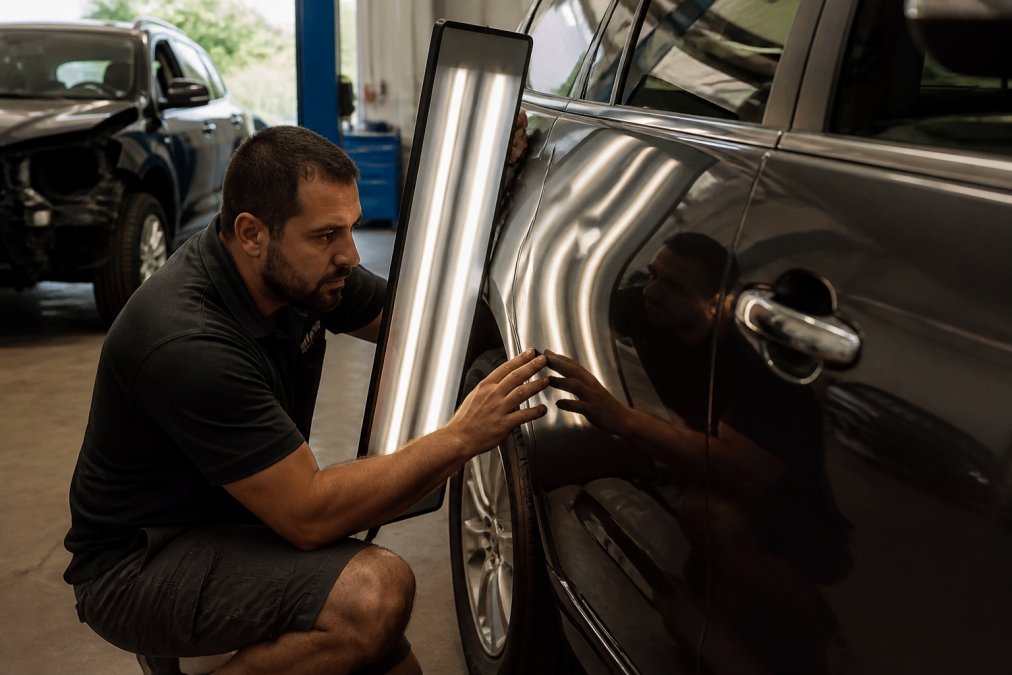
The Smartphone Flashlight Method
The 45-degree angle test: Position your phone's flashlight at 45 degrees, about 12 inches away. High spots appear as bright reflective spots; low spots create dark shadows. A quality repair shows consistent brightness with no sudden bright spots or dark pockets.
The glancing angle test: Hold your flashlight nearly parallel to the panel surface, a few inches away. This exaggerates surface irregularities. A perfect repair shows a smooth, continuous reflection with no interruptions.
The direct overhead test: Shine your flashlight straight down from above to reveal orange peel (bumpy, dimpled pattern) and halos (light-colored rings or cloudy areas around the repair).
Understanding What Light Patterns Mean
Different defects create distinct light signatures:
- Bright spots (45-degree angle): High spots from over-worked metal.
- Dark shadows (45-degree angle): Low spots from incomplete removal.
- Fragmented reflection (glancing angle): Surface irregularities indicating incomplete metalwork.
- Bumpy texture (overhead light): Orange peel from heat or aggressive tool pressure.
- Cloudy rings (overhead light): Halos from clearcoat separation (permanent).
- Uneven color shift (any angle): Paint damage or improper technique.
Professional Lighting Standards
Fluorescent work lights create harsh shadows that highlight irregularities. Shadow boards (flat, dark surfaces) create uniform reflections, distortions indicate surface problems.
When inspecting at a professional facility: ask the technician to show the repair under fluorescent lighting with a shadow board, compare it to an undamaged panel under identical lighting, and take photos to document the condition.
Multi-Angle Inspection Protocol
Use this inspection sequence: (1) daylight inspection from multiple angles, (2) 45-degree angle test for high/low spots, (3) glancing angle test for irregularities, (4) overhead test for orange peel and halos, (5) touch test for ridges or bumps, (6) comparison test against an undamaged panel. While these visual checks effectively reveal surface imperfections, detecting structural damage requires a more rigorous examination of the vehicle's underlying chassis integrity.
A quality repair looks identical to surrounding panels under every lighting condition and angle.
Questions to Ask a PDR Technician Before Repair
Asking the right questions helps you identify qualified professionals who understand quality standards. These questions reveal whether a technician has the knowledge and experience to do the job correctly.
Key questions to ask:
- How will you access the dent without damaging the panel?
- What tools and techniques will you use?
- How do you verify the repair is complete?
- What happens if the repair isn't perfect on the first attempt?
- Do you inspect the work under fluorescent lighting?
- How long will the repair last?
PDR Technician Certification Requirements and Standards
Professional certifications demonstrate that a technician has formal training and meets industry standards. However, PDR certifications are less standardized than general automotive repair, so understanding what credentials actually mean is critical.
Industry Certifications and What They Cover
ASE (National Institute for Automotive Service Excellence): ASE B3 certification covers dent repair among other work, but is broad and doesn't specifically validate PDR expertise.
What to Ask About Credentials
When evaluating qualifications, ask: How long have you performed PDR work? What specific training have you completed? Do you specialize in PDR or general work? Can you provide customer references? Are you certified for my vehicle type? Do you maintain continuing education?
Verifying Credentials
Verify credentials: ask about professional organization membership, and confirm insurance company partnerships.
Red Flags in Credential Claims
Be skeptical of:
- "Certified PDR technician" without naming the certifying organization. Legitimate certifications come from specific, verifiable sources.
- Technicians who can't explain their training. A qualified professional can describe what they learned and how it applies to your repair.
- No references or unwillingness to provide them. Quality technicians have satisfied customers willing to vouch for their work.
- Claims of "lifetime experience" but no formal training. Self-taught technicians may have developed bad habits that produce poor long-term results.
- Technicians who won't discuss their quality assurance process. Professionals have systematic inspection procedures and can explain them.
The Certification-Experience Balance
Certification alone doesn't guarantee quality work. A technician with formal training but only six months of experience may struggle with complex repairs. Conversely, a highly experienced technician without formal credentials may produce excellent work through years of practice. The ideal is both: formal training combined with substantial hands-on experience.
Post-Repair Inspection Checklist
After a technician completes your repair, perform a thorough inspection before accepting the vehicle. This checklist ensures the work meets quality standards.
Use this post-repair inspection checklist:
- Inspect panel in fluorescent lighting from multiple angles
- Run your hand across the repair to feel for ridges or bumps
- Use a shadow board to verify consistent reflection
- Check for orange peel texture or halos around the repair
- Look for any paint cracking or clearcoat separation
- Verify no visible color changes or discoloration
- Test the repair in both bright and dim lighting
- Document any concerns with photos or notes
- Request corrections immediately if defects are found
Understanding Warranties and Quality Guarantees
A comprehensive warranty protects your investment in PDR work. Quality technicians stand behind their repairs with guarantees that cover workmanship and durability.
Warranty coverage typically includes:
- Defects in workmanship for the life of the vehicle
- Paint and clearcoat issues caused by the repair
- Structural problems resulting from improper technique
Frequently Asked Questions
What are the visual signs of poor paintless dent repair?
Poor PDR work shows several red flags: high spots and low spots across the panel surface, halos or rings around repaired areas, orange peel texture inconsistencies, paint cracking or crazing, and reflections that distort when viewed from different angles. Body filler usage is also a sign the technician resorted to traditional repair methods instead of true PDR. Use fluorescent lighting and a shadow board to spot these defects, they're much harder to see in natural light.
How do I know if a PDR technician is certified?
Ask the technician about their PDR training and certifications. Certified PDR technicians have completed formal training programs that cover dent removal techniques, metal memory principles, panel access methods, and quality standards. Request documentation of their credentials before hiring. Certification demonstrates they understand proper pressure points, dent depth assessment, and how to achieve a seamless finish without damaging the vehicle's original paint.
Why is lighting so important when inspecting PDR quality?
Proper lighting reveals surface imperfections that are invisible in normal daylight. Fluorescent lighting and shadow boards create contrast that exposes high spots, low spots, and reflective inconsistencies across the repaired panel. These tools help you see whether the metal has been returned to its original shape and whether the clearcoat integrity remains intact. Without specialized lighting, poor-quality work can hide until the vehicle is viewed in different conditions.
What warranty should I expect from quality PDR work?
Quality PDR shops stand behind their work with comprehensive warranties. A lifetime warranty on the repair itself demonstrates confidence in the technician's skill and the durability of the restoration. This protects you if the dent returns or if paint issues emerge after repair. Verify the warranty covers both the dent repair and any paint-related defects.