 ultimate-guide
Is Paintless Dent Repair Permanent for Hail?
Table of Contents
- What Is Paintless Dent Repair (PDR)?
- Is Paintless Dent Repair Permanent for Hail Damage?
- How Long Does Hail Repair Take with PDR?
- Benefits of Paintless Dent Repair for Your Vehicle
- Is PDR Covered by Insurance?
- PDR vs. Conventional Body Shop Repair
- Factors That Affect PDR Effectiveness and Longevity
- Protecting Your Resale Value with Professional PDR
- Frequently Asked Questions
Last Updated: September 20, 2026
What Is Paintless Dent Repair (PDR)?
Paintless dent repair permanent solutions remove dents from vehicle body panels without repainting or body filler. Technicians use precision tools and use points to reshape metal back to its original form, preserving the factory paint finish entirely.
A trained technician accesses the back side of a dent through panel gaps or trim removal, then applies controlled pressure using specialized rods and tools to gradually restore the panel's contour. Because no paint is removed or applied, the original factory finish remains intact.
PDR works best on dents without creases or clear coat cracks. Hailstones typically create shallow to moderate dents without breaking the paint surface, the exact damage profile PDR addresses.
Is Paintless Dent Repair Permanent for Hail Damage?
Paintless dent repair is permanent when performed correctly by a certified technician. The permanence depends on two critical factors: metal memory and paint integrity.
Metal Memory and Structural Restoration
Metal memory allows aluminum and steel to return to their original shape when properly manipulated. A skilled technician applies pressure from the reverse side to gradually coax the metal back into alignment.
The restoration is permanent because the metal is reshaped, not filled. Once the panel returns to its original contour, the metal stays in place, unlike body filler, which can crack or shrink.
Permanence depends on technician expertise. Improper technique can create stress fractures or incomplete restoration. At Hail Inc., our certified technicians apply the right pressure at the right angles to ensure lasting results.
Paint Integrity and Factory Finish Protection
Paintless dent repair preserves the factory paint finish, which is thicker and more durable than paint applied in a body shop. Factory paint is applied under controlled conditions at the manufacturer's facility.
Because PDR doesn't disturb this finish, the clear coat remains unbroken, preventing moisture and rust. Hail damage repaired with PDR maintains its appearance and structural integrity for decades.
If the hailstone has cracked the clear coat or created a crease, a small area of repainting might be necessary. Professional assessment determines whether paint integrity has been compromised.
How Long Does Hail Repair Take with PDR?
Timeline varies based on damage extent. Light damage (5-10 panels) takes 1-3 days. Moderate damage (15-20 panels) requires 3-5 days. Severe damage (30+ panels) may take 1-2 weeks.
Each dent requires individual assessment. Shallow dents restore quickly; deeper or hard-to-access dents take longer.
PDR is faster than conventional repair because there's no painting or curing time. The vehicle is ready to drive as soon as the last panel is completed.
At Hail Inc., we provide daily updates and offer complimentary rental vehicles during repair.
| Damage Extent | Typical Timeline | Affected Panels |
|---|---|---|
| Light | 1-3 days | 5-10 panels |
| Moderate | 3-5 days | 15-20 panels |
| Severe | 1-2 weeks | 30+ panels |
Benefits of Paintless Dent Repair for Your Vehicle
Factory paint is engineered for durability and UV resistance. By keeping the original finish intact, you retain superior paint quality and protection.
PDR maintains structural integrity. Because metal is reshaped rather than filled, the panel remains as strong as before the damage.
Finally, paintless dent repair protects your resale value. Buyers and appraisers recognize PDR as the gold standard for hail damage repair because it preserves the factory finish and maintains structural authenticity.
Is PDR Covered by Insurance?
Most comprehensive insurance policies cover paintless dent repair for hail damage. Because PDR is recognized as a legitimate and permanent repair method, insurers typically approve it without hesitation. The repair cost is usually covered under your comprehensive coverage, subject to your deductible.
At Hail Inc., we work directly with your insurance company to manage the entire claim process. We handle the inspection, documentation, and all communication with your insurer. We also offer $0 out-of-pocket repairs, meaning we cover your deductible so you don't pay anything out of pocket, even if your insurance requires a deductible.
PDR vs. Conventional Body Shop Repair
The fundamental difference between paintless dent repair and conventional body shop work lies in the approach to restoration. PDR reshapes metal and preserves the factory finish. Conventional body work removes damaged material, fills voids, and repaints the affected area.
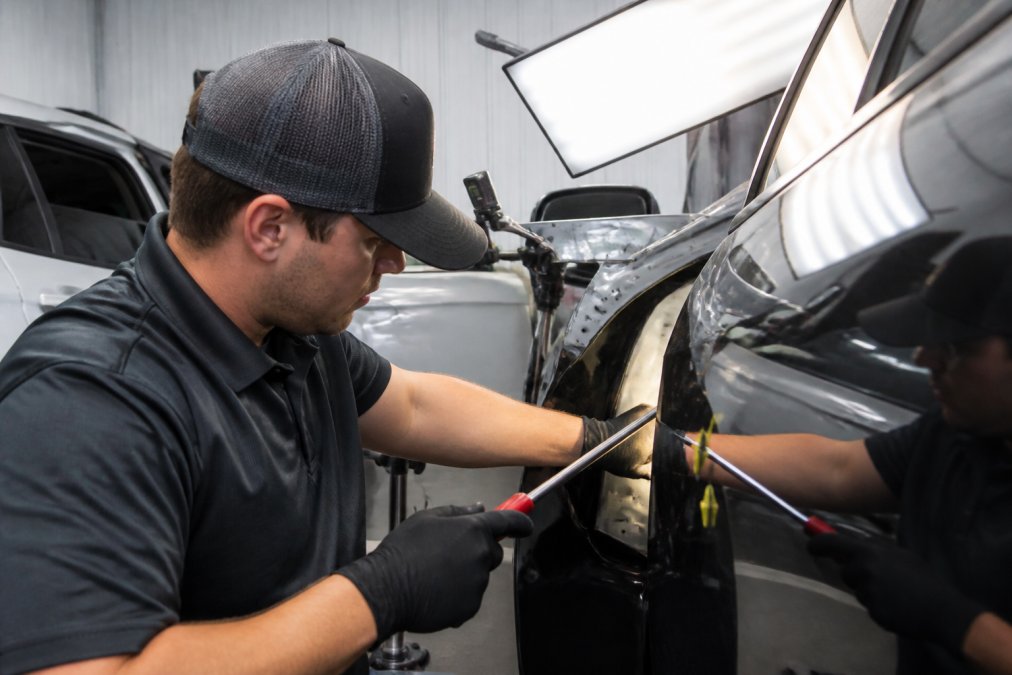
Conventional body work begins with assessment of damage severity. If the dent is deep or the metal is creased, the technician may need to remove the entire panel and replace it, or use body filler to build up the surface. Once the surface is level, the area is sanded smooth, primed, painted with base coat, and finished with clear coat. This process typically takes 1-2 weeks and involves multiple cure cycles.
The advantage of conventional body work is that it can address damage PDR cannot, severe creases, metal splits, or areas where paint has already been compromised. The disadvantage is cost, timeline, and the introduction of new paint.
PDR preserves factory paint integrity. The disadvantage is that it's limited to dents without creases or paint damage.
| Aspect | Paintless Dent Repair | Conventional Body Work |
|---|---|---|
| Timeline | 1-3 days (light damage) | 1-2 weeks |
| Paint Finish | Factory original | Shop-applied |
| Cost | Lower | Higher |
| Best For | Hail, minor dents | Severe damage, creases |
| Permanence | Permanent (metal reshaped) | Permanent (if done well) |
| Resale Impact | Preserves value | May reduce value slightly |
Factors That Affect PDR Effectiveness and Longevity
Several variables influence how well paintless dent repair works and how long the results last. The first is dent depth. Shallow dents, those less than half an inch deep, restore quickly and completely. Moderate dents take longer but typically restore fully. Very deep dents may require multiple sessions or may not be suitable for PDR if they've created metal creases.
Dent location matters significantly. Dents on flat panels like doors and quarter panels are easier to access and restore than dents on curved surfaces like roof panels or fenders. Some areas of the vehicle are difficult to reach without removing trim or panels, which extends the timeline but doesn't affect the final result.
Paint condition is critical. If the hailstone has cracked the clear coat, the dent can still be removed, but the paint damage must be addressed separately. A small area of repainting might be necessary, which slightly increases cost and timeline but doesn't compromise the overall repair quality.
Technician expertise is the most important factor. A certified technician understands metal memory, knows the correct use points for different panel types, and applies pressure gradually to avoid creating new stress points. An inexperienced technician might over-correct, under-correct, or create secondary damage. This is why certification and training matter, they directly impact the permanence and quality of your repair.
Vehicle age and metal type also play a role. Newer vehicles with aluminum panels respond differently to PDR than older vehicles with steel panels. Modern vehicles often have complex structural reinforcements that require specialized knowledge to navigate safely. Technicians at Hail Inc. are trained on multiple vehicle types and understand how to work with both traditional and modern materials.
Protecting Your Resale Value with Professional PDR
Vehicle resale value is directly affected by the quality and method of hail damage repair.
When a buyer or appraiser inspects a vehicle, they're looking for signs of previous damage and repair quality. A PDR repair is nearly invisible, the factory paint is undisturbed, the panel contours are correct, and there's no evidence of filler or repainting. This authenticity matters to buyers and significantly impacts appraisal value.
According to automotive industry data on vehicle valuation, vehicles with original factory paint command higher resale prices than those with repainted panels. A hail-damaged vehicle repaired with PDR retains its original paint and therefore maintains its value better than one repaired conventionally.
At Hail Inc., we understand that your vehicle is an asset.
Frequently Asked Questions
Will hail dents return after paintless dent repair?
No. PDR is permanent when performed by certified technicians. The metal is reshaped to its original form using precision tools and leverage points, restoring the panel's structural integrity. The repair does not rely on fillers or adhesives that degrade over time. However, the vehicle remains susceptible to new hail damage in future storms, the repair does not prevent additional impacts.
Does paintless dent repair affect the vehicle's factory finish?
PDR preserves the factory paint finish entirely. Unlike conventional body work, no paint is removed, sanded, or refinished. The clear coat and factory paint remain intact, which is why PDR maintains your vehicle's original appearance. This protection of the factory finish is one of the strongest reasons vehicle owners choose PDR over traditional repair methods.
How long does paintless dent repair take for hail damage?
PDR timelines depend on the extent of hail damage and the number of affected panels. Minor dent clusters may take one to three days, while extensive hail matrix damage across multiple panels can require one to two weeks. Technician expertise and access to affected areas also influence duration. Many facilities offer rental vehicles during the repair period so you maintain mobility throughout the process.
Is paintless dent repair covered by insurance?
Most comprehensive auto insurance policies cover PDR for hail damage. Since PDR preserves the factory finish, insurers often approve it readily. Your deductible applies as with any claim. Working with a shop that handles insurance claims directly simplifies the process, they manage documentation, estimates, and claim communication on your behalf.