
 how-to
Will Insurance Cover Your Rental Car for Hail Repair
Table of Contents
- Does Your Personal Auto Insurance Cover Rental Cars for Hail Damage?
- Understanding Comprehensive Insurance Coverage for Hail
- Rental Car Insurance Coverage Limits and What They Mean
- Credit Card Rental Car Insurance: Does It Cover Hail Damage
- Filing an Insurance Claim for Rental Vehicle Damage
- The Rental Agency's Damage Waiver vs. Your Insurance
- What to Do When Your Insurance Doesn't Cover the Rental
- Frequently Asked Questions
Last Updated: September 21, 2026
Does Your Personal Auto Insurance Cover Rental Cars for Hail Damage?
Your personal auto insurance policy likely covers rental cars if you have comprehensive coverage. But there's a catch. The coverage limits, deductibles, and exclusions vary widely. Understanding what your policy actually covers is the first step to avoiding surprise bills.
At Hail Inc., we work directly with insurance companies to help vehicle owners navigate these claims. Most people assume their insurance will cover everything. Then they get a bill for thousands in out-of-pocket costs. The real answer depends on three things: your policy type, your coverage limits, and how the rental agency structures its damage waiver.
Let's break down what you need to know.
Understanding Comprehensive Insurance Coverage for Hail
Comprehensive coverage is what protects your vehicle from hail damage. It covers weather-related damage, theft, vandalism, and other non-collision events. Hail falls squarely under comprehensive coverage.
Here's the important part: if you have comprehensive coverage on your personal auto policy, that coverage typically extends to rental cars. But extension doesn't mean unlimited coverage. Your limits and deductible still apply.
What Comprehensive Coverage Actually Protects
Comprehensive insurance coverage for hail pays for repair costs after hail strikes your rental vehicle. The insurance company covers the damage minus your deductible. Your deductible is the amount you pay out of pocket before insurance kicks in.
Most policies have deductibles between $250 and $1,000. A $500 deductible means you pay $500, and insurance covers the rest. If hail damage costs $3,000 to repair, you'd pay $500 and insurance pays $2,500.
The key word is "repair." Comprehensive coverage pays to fix the damage. It doesn't cover loss of use fees, diminished value, or rental agency markup charges. Those costs fall on you.
Deductibles and Out-of-Pocket Costs
Your deductible applies to every claim. Some policies let you lower your deductible for a higher premium. Others lock you into a standard deductible.
Rental car hail damage insurance claims work the same way. You pay your deductible first. Insurance covers the rest up to your policy limits. If you have a $500 deductible and $5,000 in hail damage, you're out $500 plus any fees the rental agency adds.
Many rental agencies charge additional fees beyond repair costs:
- Loss of use fees, charged for each day the car sits in the shop
- Administrative charges, processing and paperwork fees
- Diminished value, reduced resale value after damage and repair
These fees are contractual obligations between you and the rental agency. Your insurance typically does not cover them. That's where your out-of-pocket costs come from.
Rental Car Insurance Coverage Limits and What They Mean
Coverage limits are the maximum amount your insurance will pay. If your comprehensive coverage limit is $10,000, that's the ceiling. Hail damage rarely exceeds this on a rental car, but it's worth checking your policy.
Most personal auto policies cover rental cars at the same limits as your own vehicle. If your policy limits are $25,000, that applies to rental cars too. This is usually plenty for hail repair.
The real problem isn't the limit. It's what happens when the rental agency's damage waiver gets involved.
Primary vs. Secondary Coverage for Rentals
Primary coverage pays first. Secondary coverage kicks in only after primary coverage is exhausted.
Your personal auto insurance is typically primary for rental cars. This means your policy pays before anything else. The rental agency's damage waiver becomes secondary.
But some policies flip this. They make the rental agency's waiver primary and your insurance secondary. This matters because you might pay the rental agency's charges first, then file a claim with your insurance for reimbursement.
Check your policy documents. Call your insurance agent. Ask: "Is my comprehensive coverage primary or secondary on rental cars?" The answer changes your out-of-pocket costs significantly.
The Hidden Cost: Loss of Use Fees
Loss of use fees are daily charges the rental agency levies while your car sits in the repair shop. They're contractual, written into your rental agreement.
A typical loss of use fee runs $30 to $75 per day. If hail damage requires five days of repairs, you're looking at $150 to $375 in loss of use fees alone.
Your personal auto insurance does not cover loss of use. Your comprehensive policy covers the repair. It doesn't cover the rental agency's business loss while the car is out of service.
This is the gap most people miss. They assume insurance covers "the damage." It does. But the rental agency's fees for lost use are separate contractual charges.
Credit Card Rental Car Insurance: Does It Cover Hail Damage
Many credit cards offer rental car insurance as a cardholder benefit. This coverage is typically secondary. It applies only after your personal auto insurance is exhausted.
Credit card rental car insurance often covers comprehensive damage, including hail. But the coverage is limited. Most cards cap coverage per claim.
The catch: credit card coverage is secondary. Your personal auto insurance must be exhausted first. If your personal insurance covers the claim fully, the credit card benefit never activates.
If your personal insurance has a high deductible or low limits, the credit card coverage can help. But you still pay your personal insurance deductible first.
Filing an Insurance Claim for Rental Vehicle Damage
Filing a claim for rental car hail damage requires documentation, speed, and clear communication with both the rental agency and your insurance company.
Step 1: Document the Damage Immediately
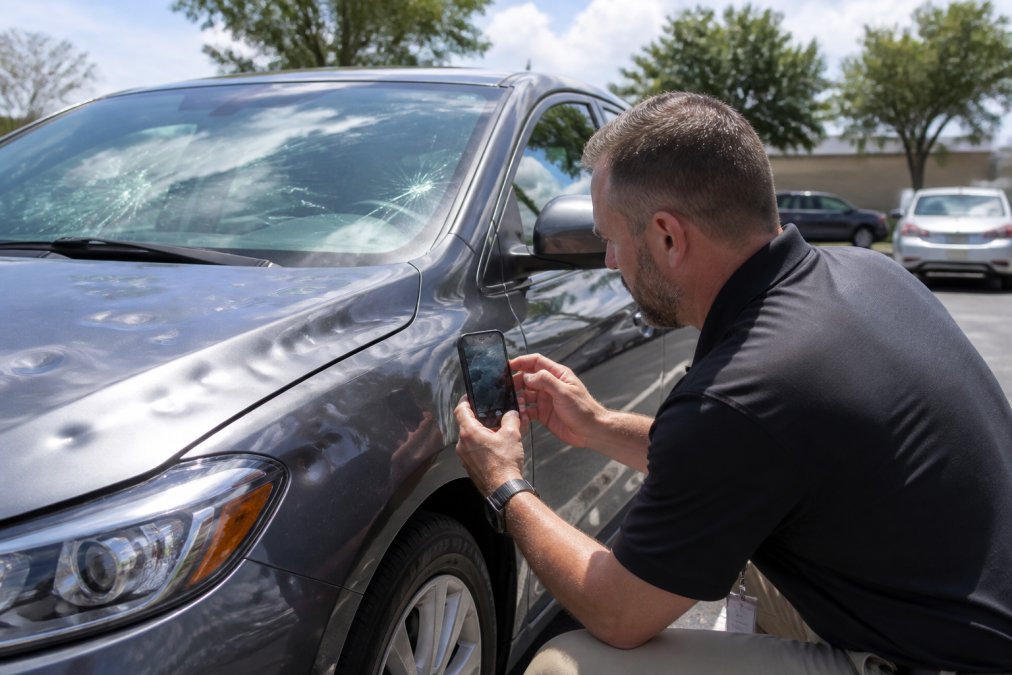
Take photos and video of every damaged panel. Use natural daylight. Capture close-ups of dents and any broken glass. Get wide shots showing the overall damage pattern.
Write down the date, time, and weather conditions. Note the hail size if you can. Document the rental car's mileage and condition at pickup.
Ask the rental agency for a damage report. Request a copy in writing. This report becomes evidence in your claim.
Don't delay. Document everything before the car leaves the rental lot. Once the car goes to the repair shop, your documentation becomes harder to gather.
Step 2: Report to the Rental Agency and Your Insurer
Contact your insurance company within 24 hours. Report the incident. Provide your policy number and claim details.
Notify the rental agency in writing. Email is best because it creates a record. Include photos and the damage report. State that you're filing an insurance claim.
Keep copies of every email and document. Insurance claims require a paper trail.
Step 3: Work With an Insurance Adjuster
Your insurance company will assign an adjuster. The adjuster inspects the damage and estimates repair costs.
The adjuster works for your insurance company. They're protecting the insurance company's interests, not yours. But they also verify that the damage is legitimate and repair estimates are reasonable.
Provide the adjuster with your documentation. Answer their questions. Be clear about what happened and when.
The adjuster's estimate becomes the basis for your claim payout.
Step 4: Review the Repair Estimate and Coverage Decision
Your insurance company will issue a coverage decision. They'll state what they'll pay and what you owe.
Review this decision carefully. If the repair estimate is higher than the insurance payout, you're responsible for the difference.
This is where loss of use fees and other rental agency charges often appear.
The Rental Agency's Damage Waiver vs. Your Insurance
Here's the trade-off:
With a damage waiver: You pay a daily fee. The rental agency covers damage. You have no out-of-pocket costs for repairs.
What to Do When Your Insurance Doesn't Cover the Rental
If your insurance denies coverage or limits are insufficient, you have options.
Frequently Asked Questions
Will my personal auto insurance cover a rental car if it gets hail damage?
Yes, if your personal auto policy includes comprehensive coverage. Comprehensive insurance covers hail damage regardless of whether you're driving your own vehicle or a rental. However, your deductible still applies to the rental car claim, and coverage limits may vary. Check your policy documents or contact your insurer to confirm your specific rental car coverage limits and any exclusions.
What's the difference between primary and secondary rental car insurance coverage?
Primary coverage pays first for any rental car damage, up to your policy limits. Secondary coverage only pays if primary coverage is exhausted or unavailable. Most personal auto policies provide primary coverage for rental cars, but some may be secondary. This distinction matters because it determines who pays first and how much you might owe out of pocket. Always verify which type your policy offers before renting.
Can I use my credit card's rental car insurance to cover hail damage?
Many credit cards offer rental car damage protection, but coverage varies significantly. Some cards cover comprehensive damage like hail, while others exclude weather-related damage. Credit card coverage is typically secondary, meaning it pays after your personal auto insurance. Read your credit card's rental car benefits guide carefully, as terms differ by card issuer and may have strict limitations.
What is a 'loss of use' fee, and will insurance cover it?
Loss of use is a daily fee rental agencies charge for the period your rental car is being repaired. It compensates the rental company for lost revenue. Insurance typically does not cover loss of use fees, making this a potential out-of-pocket expense. Some rental agreements allow you to waive this fee by purchasing the agency's damage waiver, but that waiver may not cover weather-related damage like hail. Review your rental agreement carefully before signing.