 ultimate-guide
Does Paintless Dent Repair Really Work? An Honest 2026 Guide
Table of Contents
- What Paintless Dent Repair Actually Does to Your Vehicle
- How Long Does Paintless Dent Repair Take?
- Is Paintless Dent Repair Covered by Insurance?
- The Benefits of Paintless Dent Repair for Your Vehicle's Value
- Which Dents Can Be Repaired and Which Cannot
- DIY vs. Professional Paintless Dent Repair: What You Need to Know
- Conclusion
- Frequently Asked Questions
Last Updated: September 13, 2026
What Paintless Dent Repair Actually Does to Your Vehicle
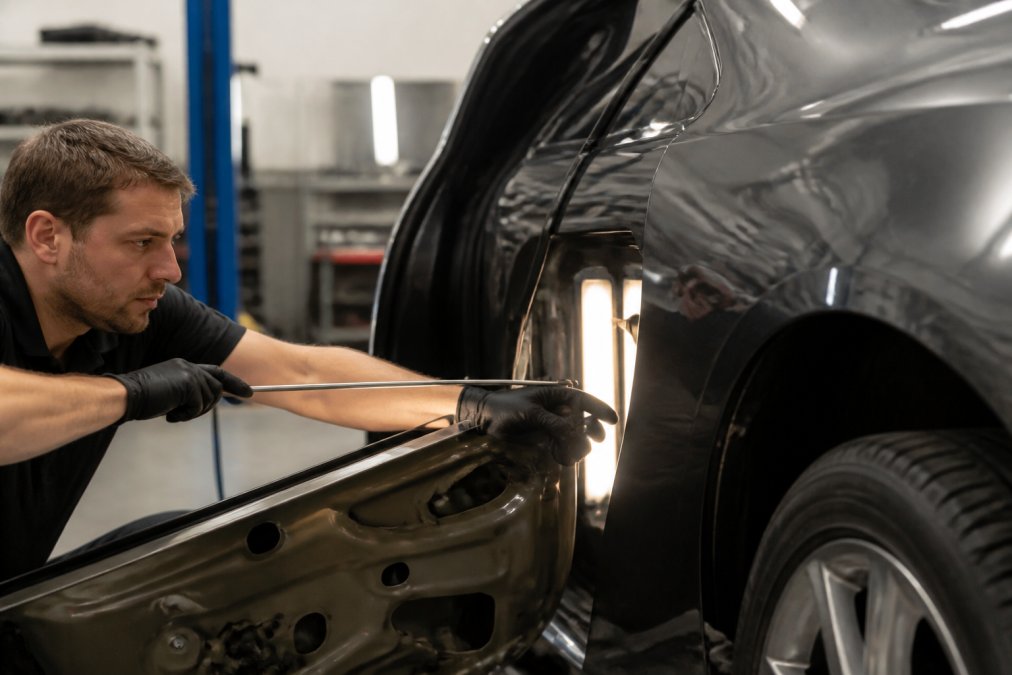
Paintless dent repair removes dents from a vehicle's body panels by working the metal back into shape from behind the panel, without sanding, filling, or repainting. At Hail Inc., we use this approach daily on vehicles across the Denver metro.
The process relies on the fact that automotive sheet metal is elastic. When a dent forms, the metal stretches and bends, but it does not lose its memory of the original shape. A technician trained in paintless dent repair accesses the back of the panel and applies controlled pressure at precise points around the dent.
The Metal Memory Principle Behind Every Repair
Steel and aluminum panels behave differently under stress. Steel holds its shape well and responds predictably to gradual pressure (steel.org). Aluminum is softer and more prone to cracking if worked too aggressively, so a technician works in small increments rather than forcing the metal (aluminum.org).
The specialized tools include rods and hooks of varying lengths and curves, each designed for a specific panel depth or access angle. Glue pulling is used when the back of a panel is blocked, such as on a roof or hood.
Why Your Factory Finish Stays Untouched
The factory finish is the most durable coating your vehicle will ever have. Repainting a panel means matching color, blending clear coat, and accepting that the new finish may not age at the same rate as the rest of the car. Paintless dent repair avoids all of that.
As long as the clear coat and paint are intact, the panel can be reshaped underneath without disturbing the surface. This is why paint integrity matters so much during the initial assessment.
How Long Does Paintless Dent Repair Take?
A full vehicle covered in hail damage typically takes one to three days.
Turnaround time depends on three factors:
- Dent count and size: A hundred hail dents across a hood and roof are not.
- Panel access: Roofs and hoods often require glue pulling, which adds time.
- Metal type: Aluminum panels require slower, more careful work than steel.
At Hail Inc., we provide continuous updates throughout the repair process and arrange a complimentary rental vehicle so your schedule stays intact.
Is Paintless Dent Repair Covered by Insurance?
Coverage for paintless dent repair depends on the cause of the damage, not the repair method. Most policies treat storm-related damage, hail being the most common, under the comprehensive portion of the policy, which typically applies regardless of fault (iii.org). The method a shop uses does not change whether a claim is approved; the cause of damage and your policy terms do.
A few practical points shape how a claim actually moves:
- Comprehensive coverage is usually optional. If you financed or leased the vehicle, the lender may require it; if you own it outright, check your declarations page.
- The deductible applies per claim, not per dent. A single hail event that dents a hood, roof, and trunk is one claim with one deductible.
- The adjuster documents damage before repair. Once a panel is worked back into shape, the original damage cannot be re-inspected, so authorization should always wait until the adjuster has finished.
- Estimates are written per panel. A PDR estimate lists dent count, panel location, and access difficulty, which is why two shops can arrive at different numbers for the same vehicle.
How the Claim Process Typically Runs
- File the claim. Report the date and cause of damage. Photos taken before any repair help establish the baseline.
- Adjuster inspection. The adjuster reviews the vehicle, confirms the damage is consistent with the reported event, and writes an estimate.
- Shop estimate and supplement. A PDR shop inspects the same vehicle and may find dents the adjuster missed, common on roofs and lower panels that are hard to see in flat light. The shop then files a supplement, a request to revise the estimate upward.
- Approval and repair. Work begins once the approved amount is confirmed.
- Deductible payment. You pay your deductible to the shop; the insurer pays the approved balance.
Supplements are routine, not adversarial, insurers expect them on hail claims because dent counts are easy to undercount.
Does PDR Affect Your Warranty?
This is one of the most common concerns for owners of newer vehicles, and the answer is generally reassuring. Paintless dent repair does not involve cutting, welding, filling, or refinishing, so it does not alter the structure or the factory finish of the panel. Manufacturer warranties cover defects in materials and workmanship, not cosmetic damage from hail or impact, so a PDR repair neither triggers nor voids coverage on the repaired panel. Extended warranties and service contracts vary by provider, so read the exclusions section if you have one.
What to Have Ready Before You File
- Your policy declarations page, so you know your comprehensive deductible
- Photos of the damage taken in daylight from multiple angles
- The date and location of the event, if you can pin it down
- Any prior repair records, so the adjuster can separate old damage from new
If you would rather not manage the back-and-forth yourself, a shop can absorb it. Ask upfront who communicates with the adjuster, who files supplements, and who handles the deductible paperwork.
The Benefits of Paintless Dent Repair for Your Vehicle's Value
The benefits of paintless dent repair extend well beyond appearance. A vehicle with original factory paint and no body filler holds its resale value better than one that has been repainted, because buyers and inspectors can verify the panels have never been cut or filled.
Three value-related advantages stand out:
- Original finish is preserved. No paint matching, no blending, no risk of a mismatched panel years later.
- No body filler means no hidden problems. Filler can shrink, crack, or trap moisture over time.
- Repair records stay clean. A non-invasive repair is easier to document and easier to explain at resale.
For vintage and newer vehicles alike, keeping the factory finish intact is the biggest factor in protecting long-term value.
Which Dents Can Be Repaired and Which Cannot
Paintless dent repair works when the metal is displaced but the paint is intact. It does not work when the paint has cracked, when the metal is stretched past its elastic limit, or when the damage sits on a panel edge or seam. Two things you can check yourself: the shape of the dent and the condition of the paint. Maintaining the integrity of the factory finish remains the primary goal for any repair, which is why many owners also consider the long-term benefits of paint protection film to prevent future surface imperfections.
Round Dents vs. Creased Dents
A round dent has a gradual slope from the surrounding panel down to the deepest point. Run your finger across it and the transition feels smooth, like the bottom of a bowl. The metal has been pushed in but not folded, so it still has enough elasticity to be worked back from behind.
A creased dent has a sharp fold line, the metal has been bent past its elastic limit and folded, not just pushed. Run your finger across it and you feel a distinct ridge or edge. Creased dents are harder to repair because the metal has stretched and lost some memory of the original shape. A technician can often improve a crease, but a perfect result may not be possible without refinishing.
A quick field test: stand at an angle to the panel so light rakes across it. A round dent shows a soft, gradual shadow. A crease shows a hard, defined line where the reflection breaks.
Reading the Paint
Paint condition is the deciding factor, and it is easier to assess than dent shape:
- Intact clear coat. The surface is smooth and reflective. PDR is usually possible.
- Spiderweb cracking. Fine hairline cracks radiating from the center of the dent mean the clear coat has fractured. Refinishing is required.
- Chalky or dull patch. The clear coat has been compromised, often by heat. PDR alone will not restore the finish.
- Flaking or exposed primer. The paint has failed. This is a refinish job.
If you are unsure, clean the panel first. Dust and road film hide the fine cracks that matter most.
Where the Dent Sits Matters as Much as the Dent Itself
Access is the other half of the equation. A technician needs a path behind the panel to push the metal back. Some locations make that easy; others block it entirely.
| What You See | Likely Repairable? | Why |
|---|---|---|
| Round dent, paint intact, flat panel | Yes | Metal can be worked back from behind |
| Sharp crease with cracked paint | No | Clear coat is broken; refinishing is required |
| Dent on a panel edge or seam | Usually no | No access point and the metal is stretched |
| Large shallow hail dent | Yes | Common PDR candidate |
| Dent over structural reinforcement | Sometimes | Depends on access behind the panel |
| Dent on a body line or character line | Sometimes | The line must be re-formed, not just pushed out |
| Dent on aluminum | Often yes, but slower | Aluminum work-hardens and cracks if forced |
The Metal Memory Principle in Plain Terms
Automotive sheet metal behaves like a spring that remembers its original shape. When a dent forms, the metal stretches and bends, but the surrounding panel still holds the memory of the factory contour. A technician uses that memory as a guide, applying controlled pressure at precise points around the dent. The larger the dent and the more the metal has stretched, the more the technician works against the loss of that memory, which is why a small round dent can often be removed completely, while a large crease may only be improved.
Visual identification is not a substitute for an in-person estimate, but it gives you a reasonable starting point and tells you which questions to ask when you get one.
DIY vs. Professional Paintless Dent Repair: What You Need to Know
DIY dent removal kits exist, and they can work on very small, shallow dents in the right conditions, but those conditions are narrow. A kit that uses suction or glue tabs applies force from the outside, the opposite of how professional paintless dent repair works.
A common mistake is heating a panel with a hair dryer or pouring hot water on it, hoping the metal will pop back. This can soften the clear coat and leave a dull patch.
Professional technicians use specialized tools, controlled lighting to read the panel's reflection, and years of practice reading how metal moves. The difference shows up most on larger dents, aluminum panels, and anything near a body line.
If you are weighing the two options, consider this:
- DIY is worth trying on: a single small dent on a flat steel panel with fully intact paint.
- Call a professional for: multiple dents, hail damage, aluminum panels, dents on creases or edges, or any dent where the paint has started to crack.
Conclusion
Hail damage rarely waits for a convenient moment, and living with a dented vehicle is not a real solution. Hail Inc. handles the entire process for you: direct insurance claim management, $0 out-of-pocket repairs, complimentary rental vehicles, valet pickup and drop-off at your home or office, and a lifetime warranty on every repair we complete. Our certified technicians restore body panels to their original condition without disturbing your factory finish. Schedule an online appointment with Hail Inc. and get your vehicle back to the way it looked before the storm.
Frequently Asked Questions
What are the downsides of paintless dent repair?
Paintless dent repair does not work on every dent. If the metal is stretched too far, if the paint is cracked or chipped, or if the dent sits on a panel edge or near a seam, PDR may not be an option. Severely creased metal often needs traditional body filler and paint matching. PDR also requires access behind the panel, so some locations are harder to reach. A professional technician can tell you during an estimate whether your specific dents qualify.
Is paintless dent repair considered a permanent solution?
Yes. When performed correctly by a trained technician, paintless dent repair restores the metal to its original shape using the metal memory principle. The factory finish stays intact, and the repair does not fade, crack, or fail over time. That is why many PDR providers, including Hail Inc., back their work with a lifetime warranty. If the repair is done properly, the panel returns to its pre-damage condition and stays that way.
How does paintless dent repair maintain the vehicle's factory finish?
Paintless dent repair works from behind the panel using specialized rods and hooks to massage the metal back into shape. The clear coat and paint are never sanded, filled, or resprayed. This means your vehicle keeps its original factory finish, which protects resale value. Traditional body shop methods require body filler and paint matching, which can be detected later and may not hold up as well as the original coating.
What dents cannot be removed with paintless dent repair?
Dents that have cracked or chipped paint, severely stretched metal, or damage along panel edges and seams are poor candidates for PDR. If the dent is too close to a structural component or the metal has lost its memory, traditional repair is the better path. A technician can identify repairable versus non-repairable dents during a visual inspection. Hail Inc. offers free on-site estimates so you know exactly what to expect before any work begins.